Walk into most jewelry stores and you will notice something right away: some colored gemstones are everywhere. Amethyst, garnet, citrine, and treated blue topaz are commonly found in large sizes and at approachable prices. Fine natural jadeite jade, however, is very different.
High-quality jadeite is rare because nature must create the right chemistry, the right pressure, the right temperature, and the right geological environment all at the same time. Even then, only a small portion of jadeite becomes beautiful enough for fine jewelry.
Rarity Begins With Chemistry
Every gemstone begins with minerals and elements from the Earth. Some gems are common because their ingredients are common and easy for nature to combine.
Quartz is a good example. It is made mainly from oxygen and silicon, two of the most abundant elements in the Earth’s crust. Because those ingredients are widely available, quartz can form in many different geological environments. This is one reason quartz, amethyst, and citrine are found so often in jewelry.
Other gemstones are far more difficult for nature to create. They may require rare elements, unusual trace minerals, or very specific rock conditions.
For example, emerald belongs to the beryl family. To form, beryl needs oxygen, silicon, aluminum, and beryllium. Beryllium is not nearly as common as oxygen or silicon. For emerald to become rich green, nature must also add chromium or vanadium. These coloring elements may exist only in tiny concentrations—sometimes described in “parts per million.”
That means emerald is rare not just because it is beautiful, but because the ingredients and geological setting required to create it are uncommon.
Jadeite follows the same principle, but in its own unique way.
Jadeite Has a Very Specific Mineral Formula
Scientifically, jadeite is a pyroxene mineral with the chemical formula NaAlSi₂O₆. This means it is made from sodium, aluminum, silicon, and oxygen.
These elements are not all rare by themselves. In fact, silicon, oxygen, and aluminum are very common in the Earth’s crust. What makes jadeite rare is not simply the ingredients—it is the exact natural environment required to turn those ingredients into jadeite.
Nature has to place the right elements under high pressure, relatively low temperature, and the movement of mineral-rich fluids deep within the Earth. This is a much more limited formation environment than many other gemstones.
Jadeite Forms Under Rare Geological Conditions
Jadeite is closely connected to subduction zones, where one tectonic plate is pushed beneath another. These areas create intense pressure deep below the Earth’s surface.
In these environments, sodium-rich fluids can move through rocks and interact with aluminum- and silica-bearing material. When the chemistry, pressure, and temperature are right, jadeite can begin to form.
This is why jadeite is not found everywhere. It does not simply grow in any ordinary rock pocket. The Earth has to create a very specific geological recipe.
For jadeite to become available for jewelry, even more has to happen. The jadeite must form deep underground, survive geological movement, and eventually be brought close enough to the surface to be mined.
That journey alone makes fine jadeite exceptional.
Fine Jadeite Is Rare Even After It Forms
Not all jadeite is valuable. In fact, most jadeite rough is not the vivid, translucent, clean material people imagine when they think of fine jade.
Many pieces are too opaque, too gray, too fractured, too included, or uneven in color. Fine jewelry-quality jadeite must have a rare combination of qualities:
Rich natural color
High translucency
Fine crystal texture
Strong structure
Minimal cracks or impurities
Even color distribution
This is why two pieces of jadeite can have completely different values. They may both be jadeite, but their quality can be worlds apart.
Color Makes Jadeite Even Rarer
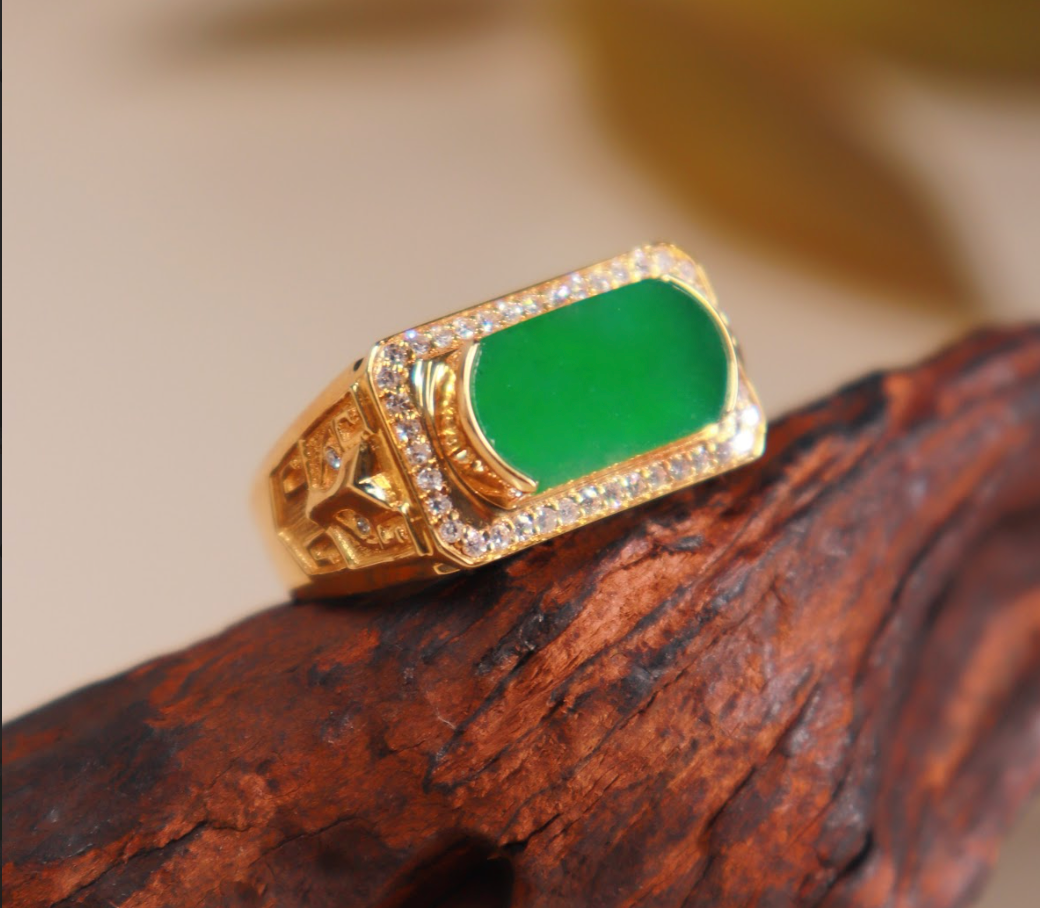
Pure jadeite can be white or colorless. The beautiful colors people love—green, lavender, yellow, red, icy white, and black—come from trace elements and mineral impurities.
The finest green jadeite, often called imperial green, requires the right coloring elements in just the right amount. Too little color, and the jade may look pale. Too much iron or uneven mineral distribution, and the jade may appear dark, gray, or patchy.
Nature has to balance the color perfectly.
That is why vivid, even, translucent green jadeite is so rare. It is not enough for jadeite to form. It must also form beautifully.
Why Jade Bangles Are Especially Expensive
Jade bangles are one of the most valuable forms of jadeite jewelry because they require a large, clean, continuous piece of rough.
A pendant, bead, or small carving can often be made from a smaller section of jade. A bangle needs much more material. The stone must be strong enough and clean enough to be cut into a full circle without major cracks running through it.
This is extremely difficult.
A jade boulder may look promising on the outside, but the inside can reveal fractures, cloudy areas, uneven color, or sections that cannot be used. Even from a large piece of rough, only a few fine bangles may be possible—or sometimes none at all.
The larger the bangle size, the harder it becomes to find suitable material.
This is one reason fine jade bangles can cost significantly more than smaller jade pieces. They require not only rare jadeite, but rare jadeite in a large, clean, wearable form.
Natural Untreated Type A Jadeite Is the Most Valuable
Modern treatments can make lower-quality jade look more attractive. Some jadeite is acid-bleached to remove impurities, then filled with polymer to improve appearance. Some pieces are also dyed to create stronger color.
But treated jade is not the same as natural untreated jade.
Natural untreated Type A jadeite has not been dyed, acid-bleached, or polymer-filled. Its color, texture, and translucency come from nature alone.
This is why Type A jadeite is the standard for serious collectors. It represents the natural beauty of jadeite exactly as the Earth created it.
Why Jadeite Costs So Much
Jadeite jade is expensive because it is rare at every level.
It is rare for nature to create jadeite.
It is rare for jadeite to form in beautiful color.
It is rare for that color to be even and vivid.
It is rare for the jade to be translucent and fine-textured.
It is rare to find large clean pieces suitable for bangles.
And it is especially rare to find untreated Type A jadeite with all of these qualities together.
The value of jadeite is not based on beauty alone. It reflects chemistry, geology, craftsmanship, cultural meaning, and limited natural supply.
The True Beauty of Jadeite
When you wear a piece of fine natural jadeite jade, you are wearing something that took millions of years and extraordinary geological conditions to create.
It is not a stone that nature produces easily. The right elements had to come together. The right pressure and temperature had to exist. The jade had to survive deep geological movement. Then, after all of that, it still had to be beautiful enough to cut, carve, polish, and wear.
That is what makes jadeite jade so special.
Fine jadeite is not just rare because people love it. It is loved because it is rare, meaningful, durable, and naturally beautiful.
That is why high-quality natural jadeite jade has been treasured for generations—and why the finest pieces continue to be among the most valuable gemstones in the world.
At Baikalla, we specialize in natural untreated Type A jadeite, carefully selected for its color, translucency, texture, and lasting beauty. Every piece of jade tells a story of nature, time, and craftsmanship—from the rare geological conditions that formed it deep within the Earth to the hands that cut, carve, and polish it into something meaningful. For us, jadeite is more than a gemstone. It is a symbol of protection, heritage, love, and beauty that can be treasured for generations.